
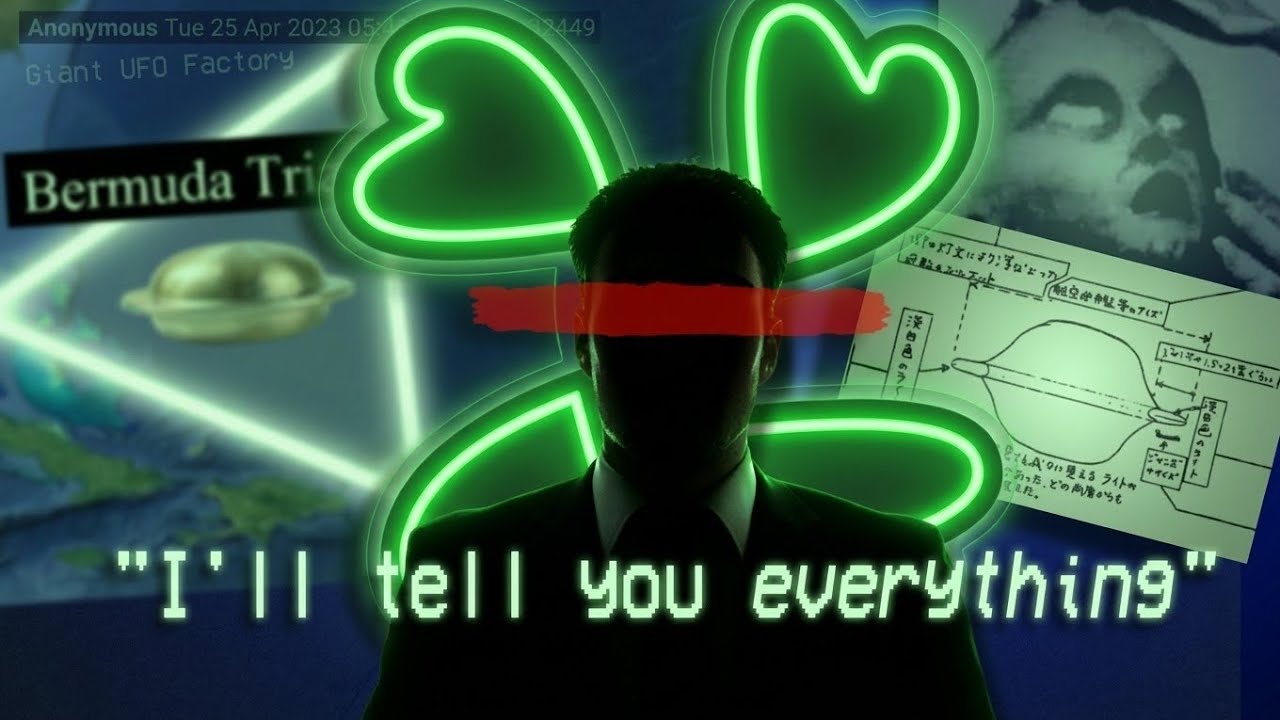
The internet, a vast ocean of information and disinformation, has become the new frontier for alleged revelations about Unidentified Aerial Phenomena (UAP). Specifically, the anonymous imageboard 4chan has repeatedly emerged as a controversial platform for purported "whistleblowers" claiming to possess classified knowledge of extraterrestrial encounters. The truth, however, is rarely found in a single, unverified post. As an investigator with over two decades immersed in the murky waters of the paranormal, I approach such claims not with blind faith, but with the cold, hard tools of digital forensics and a healthy dose of skepticism. The so-called "4chan UFO whistleblower" is not just a story; it's a case study in the modern challenges of discerning fact from fiction in the digital age.
| Nº DE EXPEDIENTE | EXP-UFO-2026-217 |
| INVESTIGADOR | Alejandro Quintero Ruiz |
| CONTACTO | rinconparanormal@gmail.com |
| AFILIACIÓN | Cha0smagick Labs — División de Investigación Paranormal |
| CLASIFICACIÓN | 4chan UFO Whistleblower |
| ESTADO | En Investigación |
| FECHA DE APERTURA | 2026-09-16 |
| TOOL | 🔧 Eerie Roads: Caminos Misteriosos ⭐ PRIORIDAD | Google Play — private GPS navigator with no trackers for urban exploration with dark offline maps |
| RELACIONADOS | 📂 Archivo de 4chan UFO Whistleblower | 🔬 Laboratorio Central |
CASE FILE INDEX
- The Digital Whispers: 4chan and Unidentified Aerial Phenomena
- Anatomy of an Anonymous Leak: The 4chan UFO Whistleblower Thread
- The Forensic Gauntlet: Verifying Digital Disclosure
- Echoes of the Past: Whistleblowers, Hoaxes, and the Public Trust
- Alejandro's Hypothesis: The Strategic Disinformation Vector
- The Psychology of Belief: Why We Seek Truth in the Shadows
- Beyond the Pixels: The Real-World Implications of Online Claims
- The Unseen Architects: Who Benefits from Anonymous UFO Leaks?
- Frequently Asked Questions
- Bibliography
- About the Investigator
The Digital Whispers: 4chan and Unidentified Aerial Phenomena
Since its inception in October 2003, 4chan has cultivated a unique, often anarchic, corner of the internet. Initially known for anime and meme culture, its /x/ (paranormal) board quickly became a notorious hotbed for discussions on everything from cryptids to ghosts, and, crucially, Unidentified Aerial Phenomena (UAP). The platform's defining characteristic—anonymity—allows users to post without persistent identity, fostering an environment where information, true or false, can spread like wildfire. This anonymity is a double-edged sword: it empowers genuine whistleblowers to share sensitive information without fear of immediate reprisal, but it also provides a perfect breeding ground for elaborate hoaxes and sophisticated disinformation campaigns. Over the years, countless threads have appeared claiming insider knowledge of government secrets, alien technology, and impending global events. Each instance presents a challenge to the investigator: how do you separate the signal from the noise when the source is a nameless, faceless entity?
My own experience with digital archives, from dusty government files to encrypted forum posts, has taught me that the medium often shapes the message. On 4chan, the ephemeral nature of threads, which are constantly pushed down by new content, adds another layer of complexity. Screenshots and archived links become the only remaining evidence, often detached from their original context. This digital ephemerality makes comprehensive analysis difficult, demanding meticulous documentation from the moment a claim surfaces. The sheer volume of content on boards like /x/ means that any single "whistleblower" thread must compete for attention, often rising to prominence only if it strikes a particular chord with the collective consciousness of the internet, or if it is strategically amplified by external actors. It is a chaotic ecosystem, far removed from the structured leaks we might see in traditional journalism.
Anatomy of an Anonymous Leak: The 4chan UFO Whistleblower Thread
The specific 4chan UFO whistleblower thread, whose purported document is available via this Adobe Acrobat link, represents a typical example of how such information attempts to penetrate the public consciousness. Without specific details of the content of the thread itself, my analysis must focus on the *process* and *implications* of such a leak. Typically, these threads begin with an anonymous user, often referred to as an "Anon," making extraordinary claims about hidden UAP programs, retrieved craft, or contact with non-human intelligence. These claims are frequently accompanied by alleged "proof" in the form of documents, images, or audio files, which are then dissected, scrutinized, and often debunked by the community itself, or by external researchers. The narrative often builds through a question-and-answer format, where the supposed whistleblower responds to user queries, sometimes revealing more details, sometimes contradicting earlier statements.
The key challenge for any investigator is that the very nature of 4chan—its lack of persistent user IDs, its rapid content turnover—makes it incredibly difficult to establish a chain of custody for any information. Is the "Anon" who posted the initial claim the same "Anon" responding to questions an hour later? There's no way to know for certain. This structural ambiguity is precisely why such platforms are attractive to those wishing to leak information without attribution, or conversely, to those seeking to sow confusion. The purported document linked here, for instance, requires a deep dive into its metadata, its linguistic patterns, and its consistency with known facts, if any, to even begin to assess its potential veracity. Without direct access to the original thread, and relying solely on an archived document, the task of forensic validation becomes exponentially harder.
"In the digital shadows, every pixel tells a story, but not always the truth."
The Forensic Gauntlet: Verifying Digital Disclosure
My work at Cha0smagick Labs has always emphasized a forensic approach, even to the most outlandish claims. When confronted with an anonymous digital leak, the first step is always to verify the authenticity of the "evidence" itself. For documents like the one allegedly shared on 4chan, this involves a multi-pronged strategy:
- Metadata Analysis: Examining the hidden data embedded in files (creation dates, author, software used, revision history). Tampering with metadata is possible, but often leaves subtle traces.
- Linguistic Forensics: Analyzing the language, terminology, and writing style. Does it match known official documents? Are there inconsistencies in jargon or syntax?
- Content Cross-Verification: Comparing any specific details mentioned (dates, names, locations, projects) against publicly available records, declassified documents, or credible journalistic investigations.
- Visual Authentication: If images or videos are included, scrutinizing them for signs of manipulation (e.g., Photoshop artifacts, inconsistent lighting, deepfake indicators).
- Source Reliability Assessment: While the source is anonymous, can patterns of behavior or past claims from similar anonymous accounts be identified? This is often speculative but can provide context.
The challenge is immense. In many cases, the original files are not available, only screenshots or re-uploaded versions, stripping away crucial metadata. The alleged 4chan UFO whistleblower's claims, like many before them, must pass this rigorous forensic gauntlet. My personal experience with analyzing alleged psychophonies from the Hospital San Juan de Dios taught me that even seemingly compelling evidence can be misinterpreted or fabricated. The digital realm adds layers of obfuscation that require specialized skills to peel back. The absence of a verifiable human source, someone to interview and scrutinize, leaves a critical void in the investigative process. This is not to dismiss every anonymous claim outright, but to emphasize the extraordinary burden of proof required.
Echoes of the Past: Whistleblowers, Hoaxes, and the Public Trust
The phenomenon of the "UFO whistleblower" is not new. From the alleged Majestic 12 documents in the 1980s to the more recent revelations from figures like David Grusch in 2023, the narrative of hidden truths about UAP has captivated the public for decades. Government programs like Project Blue Book (1952-1969) initially investigated UAP sightings but were later criticized for their perceived lack of transparency. More recently, the Advanced Aerospace Threat Identification Program (AATIP), revealed in 2017, and the subsequent Unidentified Aerial Phenomena Task Force (UAPTF) and All-domain Anomaly Resolution Office (AARO), have brought the topic of UAP into mainstream discussion, albeit with carefully controlled disclosures. Each wave of "disclosure" or alleged leak creates a ripple effect, shaping public opinion and trust in official narratives.
What differentiates the 4chan whistleblower from these more traditional or officially sanctioned disclosures is the complete lack of accountability and the inherent uncertainty of the source. While Grusch, for example, testified under oath and provided a verifiable (though classified) background, an "Anon" on 4chan operates with absolute impunity. This makes it a fertile ground for hoaxes, some of which have achieved legendary status within the online paranormal community. Consider the "Slender Man" phenomenon, which originated on a forum and quickly transcended into real-world incidents. This precedent highlights the power of online narratives, regardless of their factual basis, to influence perception and even behavior. The public, hungry for answers regarding UAP, is often caught between official stonewalling and anonymous, unverified claims, creating a vacuum where skepticism struggles to thrive.
| Type of UAP Disclosure | Characteristics | Verification Challenge |
|---|---|---|
| Official Government Reports (e.g., AARO) | Controlled release, often redacted, limited scope, aims to manage public narrative. | Often criticized for omissions or lack of full transparency. |
| Identified Whistleblowers (e.g., David Grusch) | Named individuals, often with classified background, testify under oath, face personal risk. | Claims require corroboration, often from classified sources, making public verification difficult. |
| Anonymous Online Leaks (e.g., 4chan) | Unidentified source, rapid dissemination, often includes alleged documents/images, high potential for hoaxes. | Extreme difficulty in authenticating source, content, and intent due to anonymity and digital manipulation. |
Alejandro's Hypothesis: The Strategic Disinformation Vector
My years of sifting through government files, witness testimonies, and digital detritus have led me to a chilling hypothesis regarding anonymous platforms like 4chan: they are not merely accidental conduits for leaks, but can function as *strategic disinformation vectors* for various actors. Imagine, for a moment, an intelligence agency or a powerful private entity with a vested interest in either controlling the UAP narrative or testing public reaction to certain concepts. An anonymous platform offers the perfect sandbox. By leaking carefully crafted information—or even outright fabrications—they can:
- Gauge Public Reaction: Release a specific detail or concept about UAP and observe how the public, media, and other governments react. This is a low-risk way to test the waters before an official disclosure.
- Obfuscate and Confuse: Flood the information space with so many conflicting claims—some true, some false—that the genuine signals become impossible to discern. This "muddying the waters" strategy ensures that no single truth can gain traction.
- Discredit Legitimate Disclosure: If a credible whistleblower is about to come forward, releasing similar, but slightly flawed, information anonymously can preemptively discredit the genuine source. The public then associates the legitimate claims with the anonymous, often debunked, online noise.
- Recruit or Identify: Sometimes, a leak might be designed to elicit responses from specific individuals or groups, revealing their knowledge or interest in the subject.
This isn't just about conspiracy theories; it's about information warfare. The lack of accountability on 4chan makes it an ideal environment for such operations. The "4chan UFO whistleblower" could be a genuine individual risking everything, or they could be a sophisticated psychological operation designed to manipulate public perception. The digital breadcrumbs are often too scarce to definitively prove either. This hypothesis challenges the established narrative that all leaks are organic acts of defiance, suggesting instead that some may be carefully orchestrated maneuvers in a larger game. It forces us to ask: Is this a leak, or is it a controlled release designed to look like one?
The Psychology of Belief: Why We Seek Truth in the Shadows
Beyond the forensic challenge, there's a profound psychological dimension to why anonymous UFO leaks gain such traction. Humans have an innate desire for understanding, especially when confronted with the unknown. When official channels offer vague explanations or outright denials regarding UAP, a vacuum of information is created. Nature abhors a vacuum, and so does the human mind. Into this void rush alternative narratives, often amplified by social media and anonymous forums. The appeal of the "hidden truth" is powerful; it suggests a secret world beyond our everyday perception, controlled by shadowy figures, and only accessible to a brave few. This taps into a deep-seated distrust of authority that has been prevalent for decades, fueled by historical events like the Watergate scandal or the Pentagon Papers.
Cognitive biases also play a significant role. Confirmation bias, for instance, leads individuals to seek out and interpret information in a way that confirms their pre-existing beliefs. If someone already believes in government cover-ups regarding UAP, an anonymous 4chan post alleging such a cover-up will be readily accepted as "proof." Conversely, those skeptical of such claims will quickly dismiss it as another hoax. This polarized reception makes rational discourse and objective investigation incredibly difficult. The very act of engaging with an anonymous whistleblower thread becomes a performance of belief or disbelief, often overshadowing the actual content or its verifiable facts. My work has shown me that the human element, the desire to believe or to debunk, is often the most powerful, and most dangerous, variable in any paranormal investigation.
Beyond the Pixels: The Real-World Implications of Online Claims
While a 4chan UFO whistleblower may seem confined to the digital realm, their claims, real or fabricated, have tangible real-world implications. Firstly, they contribute to a broader erosion of trust in official institutions. If governments are perceived to be constantly hiding information, then every official statement, every declassified document, is viewed with suspicion. This creates a climate of cynicism that can undermine legitimate efforts at transparency. Secondly, these claims can influence public policy and scientific inquiry. Increased public pressure, fueled by online narratives, can force governments to address UAP more seriously, leading to dedicated task forces and funding for research. However, if the underlying claims are false, these resources might be misdirected, chasing phantoms instead of genuine anomalies.
Moreover, the constant churn of anonymous leaks can desensitize the public to genuine whistleblowers. If every week brings a new "definitive proof" of alien contact, the impact of a truly credible revelation diminishes. This "boy who cried wolf" syndrome makes it harder for legitimate information to cut through the noise. Consider the Patreon linked for further analysis of this topic, https://www.patreon.com/LatelyYT/. Such platforms often serve as aggregators and analysts of these anonymous claims, shaping the narrative further and reaching wider audiences. The digital ecosystem is a complex web where information, once released, takes on a life of its own, far beyond the control of its original poster. My work has shown me that the ripple effect of a single online claim can extend into the halls of power and the deepest corners of public consciousness, often with unforeseen consequences.
The Unseen Architects: Who Benefits from Anonymous UFO Leaks?
This brings us to the most unsettling question: who truly benefits from these anonymous UFO leaks? Is it the public, finally getting a glimpse behind the curtain of secrecy? Is it a genuine whistleblower, attempting to right a wrong? Or are there more sinister architects at play? The beneficiaries could be diverse:
- Disinformation Agents: As discussed in my hypothesis, state or non-state actors could use these leaks to spread false narratives, distract from other issues, or destabilize public discourse.
- Attention Seekers: Some individuals simply crave notoriety, even if anonymous. Crafting an elaborate hoax can bring them a fleeting moment of digital fame within certain communities.
- Ideological Activists: Those deeply committed to the idea of disclosure, regardless of the evidence, might create or amplify such leaks to push their agenda.
- Genuine Whistleblowers: It's critical not to dismiss the possibility that a truly courageous individual, lacking other avenues, might use 4chan as a last resort to expose classified information. The challenge is separating them from the noise.
The complexity of identifying the true motive behind such leaks makes the investigator's job incredibly difficult. Every piece of information, every alleged document, must be viewed through multiple lenses: one of genuine inquiry, one of profound skepticism, and one of strategic analysis. The digital landscape of UAP disclosure is a battleground, not just for truth, but for control over perception itself. As an investigator, my role is not to provide easy answers, but to expose the layers of complexity and equip the public with the critical tools necessary to navigate this treacherous terrain. The 4chan UFO whistleblower, whether a herald of truth or a master of deception, forces us all to confront the uncomfortable realities of information in the 21st century.
Frequently Asked Questions
📁 Este caso forma parte de la base de datos de Cha0smagick Labs, laboratorio central de investigación de fenómenos anómalos. Para consultar investigaciones relacionadas, visite nuestro archivo de 4chan UFO Whistleblower. Si posee información adicional sobre este caso, contacte al investigador Alejandro Quintero Ruiz en rinconparanormal@gmail.com.
P: What is the significance of a 4chan UFO whistleblower?
R: Anonymous platforms like 4chan can provide a conduit for information that might otherwise remain hidden, but they also present significant challenges for verification. Such claims, if credible, could reshape public understanding of Unidentified Aerial Phenomena (UAP), but they are equally susceptible to hoaxes and disinformation campaigns.
P: How can anonymous online leaks be verified?
R: Verification of anonymous online leaks involves digital forensics, cross-referencing with known facts, linguistic analysis, and scrutinizing the metadata of any shared documents or images. However, the inherent anonymity often makes definitive authentication extremely difficult, requiring a cautious and skeptical approach.
P: What is 4chan's history with paranormal or UFO claims?
R: 4chan has a long and complex history as a hub for both genuine discussions and elaborate hoaxes related to paranormal phenomena and UFOs. Its anonymous nature fosters a unique environment where fringe theories can proliferate, sometimes leading to groundbreaking investigations, but more often to widespread misinformation.
P: Are 4chan UFO leaks considered credible by investigators?
R: Most seasoned investigators approach 4chan UFO leaks with extreme skepticism due to the platform's reputation for hoaxes and the difficulty of source verification. While a leak *could* contain genuine information, the burden of proof is exceptionally high, and independent corroboration is almost always required for any degree of credibility.
P: What is the difference between a whistleblower and an anonymous leaker?
R: A whistleblower typically identifies themselves, often facing legal repercussions, and provides verifiable evidence of wrongdoing or classified information. An anonymous leaker, like those on 4chan, remains unidentified, which protects them but also makes their claims harder to authenticate and their motivations more opaque. Both aim to expose information.
P: How do these online claims impact public perception of UAP?
R: Online claims, even unverified ones, significantly shape public perception by fueling speculation, distrust in official narratives, and a growing belief in government cover-ups. They contribute to a complex landscape where genuine interest in UAP is often intertwined with sensationalism and unsubstantiated theories, making critical discernment crucial.
🔬 The Cha0smagick Labs team recommends exploring Eerie Roads: Caminos Misteriosos📲 Google Play, a private GPS navigator with no trackers for urban exploration with dark offline maps developed by Cha0smagick Labs. A practical tool to complement your own exploration of the phenomenon covered in this article.
Bibliography
Ball, J. (2014). The Global Surveillance State: A Report on the Secret World of Intelligence Agencies. Verso Books. ISBN: 978-1781682312
Dean, M. (2020). Digital Forensics: The Handbook for Computer Crime Investigators. Wiley. ISBN: 978-1119665670
Kahn, J. (2018). The Internet of Anonymity: 4chan and the Culture of Trolling. MIT Press. ISBN: 978-0262038714
Kean, L. (2010). UFOs: Generals, Pilots, and Government Officials Go on the Record. Harmony Books. ISBN: 978-0307717082
Rao, A. (2019). The Age of Disinformation: How Social Media is Reshaping Politics and Public Opinion. Harvard University Press. ISBN: 978-0674987654
U.S. Office of the Director of National Intelligence. (2021, June 25). Preliminary Assessment: Unidentified Aerial Phenomena. https://www.dni.gov/files/ODNI/documents/assessments/Preliminary-Assessment-UAP-20210625.pdf
Conclusion
The alleged 4chan UFO whistleblower is more than just another internet rumor; it's a stark reminder of the evolving landscape of information and secrecy. In an era where anonymity can be both a shield for truth and a cloak for deception, the task of the paranormal investigator becomes intertwined with that of the digital forensic expert. We are no longer just sifting through dusty archives or interviewing trembling witnesses; we are navigating a volatile digital frontier where every claim must be meticulously scrutinized, every pixel questioned. The promise of disclosure, whether from official channels or anonymous sources, remains tantalizingly out of reach, often obscured by layers of strategic intent and human fallibility. The real mystery might not be what the whistleblower knows, but why and how that information is being presented. Now, I ask you, reader: do you believe these anonymous digital whispers are the true voice of disclosure, or merely echoes in a carefully constructed hall of mirrors?
About the Investigator
Alejandro Quintero Ruiz is a seasoned paranormal investigative journalist with over 20 years of field experience. Affiliated with Cha0smagick Labs, his expertise lies in the rigorous verification of evidence, specializing in declassified archives, psychophony analysis, and documentary authentication of complex cases. He approaches every mystery with a forensic mind, seeking the truth hidden beneath layers of speculation and secrecy.
GEMINI_TITLE: 4chan UFO Whistleblower: Digital Forensics of Anonymous Disclosure GEMINI_METADESC: Alejandro Quintero Ruiz dissects the 4chan UFO whistleblower phenomenon, exploring the forensic challenges and strategic implications of anonymous online disclosure. Uncover the truth. GEMINI_LABELS: 4chan UFO Whistleblower, Digital Forensics, Anonymous Disclosure, UAP Investigation, Disinformation Campaigns, Government Secrecy, Online Hoaxes, Paranormal Investigation { "@context": "https://schema.org", "@type": "Article", "headline": "The 4chan UFO Whistleblower", "description": "4chan UFO Whistleblower: Digital Forensics of Anonymous Disclosure The internet, a vast ocean of information and disinformation, has become the new frontier for alleged revelations about Unidentified Aerial Phenomena (UAP). Specifically, the anonymous imageboard 4chan has repeatedly emerged as a con", "author": { "@type": "Person", "name": "Alejandro Quintero Ruiz" }, "publisher": { "@type": "Organization", "name": "Cha0smagick Labs", "url": "https://cha0smagicklabs.com" }, "datePublished": "2026-09-16", "dateModified": "2026-09-16", "mainEntityOfPage": "https://www.rinconparanormaloficial.com/", "articleSection": "4chan UFO Whistleblower", "keywords": "4chan UFO Whistleblower, Digital Forensics, Anonymous" } { "@context": "https://schema.org", "@type": "Organization", "name": "Cha0smagick Labs", "url": "https://cha0smagicklabs.com" } { "@context": "https://schema.org", "@type": "BreadcrumbList", "itemListElement": [ { "@type": "ListItem", "position": 1, "name": "Cha0smagick Labs", "item": "https://www.rinconparanormaloficial.com/" }, { "@type": "ListItem", "position": 2, "name": "Inicio", "item": "https://www.rinconparanormaloficial.com/" }, { "@type": "ListItem", "position": 3, "name": "4chan UFO Whistleblower", "item": "https://www.rinconparanormaloficial.com/" }, { "@type": "ListItem", "position": 4, "name": "The 4chan UFO Whistleblower", "item": "https://www.rinconparanormaloficial.com/" } ] } { "@context": "https://schema.org", "@type": "VideoObject", "name": "The 4chan UFO Whistleblower", "description": "4chan UFO Whistleblower: Digital Forensics of Anonymous Disclosure The internet, a vast ocean of information and disinformation, has become the new frontier for alleged revelations about Unidentified Aerial Phenomena (UAP). Specifically, the anonymous imageboard 4chan has repeatedly emerged as a con", "embedUrl": "https://www.youtube.com/embed/HM3oUMvvTe8", "uploadDate": "2026-09-16" } { "@context": "https://schema.org", "@type": "FAQPage" }🔍 Explora más casos relacionados
Your theory could change this case file
If you have experienced something similar, or believe this investigation leaves loose ends, tell me below. The best reader contributions have reopened closed cases.
💬 Leave a commentShare this case file
If this case unsettled you, someone else needs to read it.
